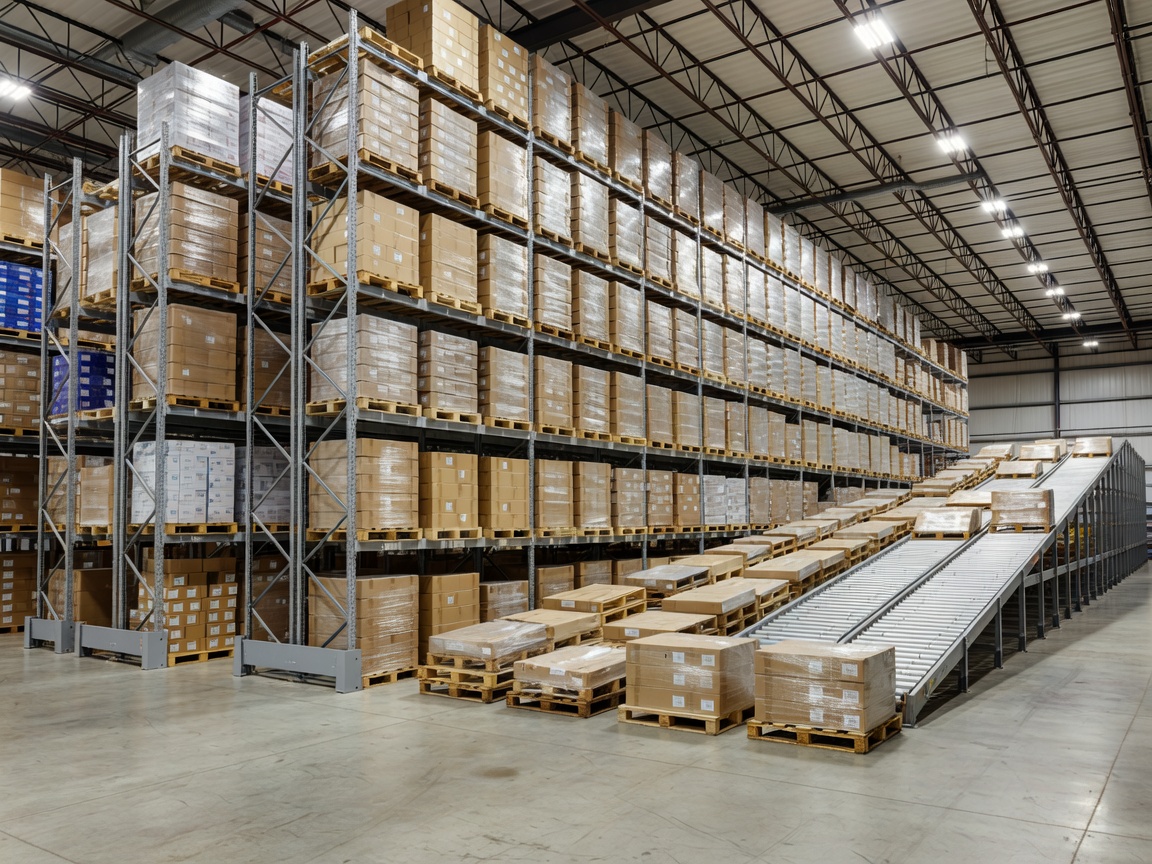
A warehouse may combine several storage zones, or be designed around a narrower cargo profile. Before comparing facilities, record product dimensions, weight, packaging, movement frequency, environmental needs and any special handling constraints.
General and pallet storage
A general warehouse is a broad category for goods held in a building designed for storage and movement. The actual building may use floor positions, shelving, racks or a mix. Ask how stock is identified, accessed and protected, and whether the operating model supports the inventory profile.
Pallet storage uses standardised or product-specific load units placed on the floor or in racking. Racking can increase storage density and organise access, but the layout has to suit pallet dimensions, load characteristics, handling equipment and the movement pattern. Selective arrangements can make individual loads more directly accessible; denser arrangements can reduce access flexibility. Facility layout and operating rules determine the practical trade-off.
Bulk and specialized storage
Bulk storage handles goods held in larger quantities or formats rather than conventional pallet positions. The term covers a range of cargo and methods. Confirm the physical form, packaging, handling method, containment needs and separation from other goods before assuming that a general facility can accommodate it.
Specialized storage is defined by a particular product or operating requirement. It may involve dedicated equipment, security controls, handling procedures or environmental conditions. Ask the operator to specify what is included, what is excluded and which party is responsible for monitoring and records. Do not infer capability from a facility name or photograph.
Temperature and humidity conditions
Cold storage and temperature-controlled facilities are intended to keep goods within defined environmental conditions. The required range depends on the product and its supply chain. Establish acceptable limits, monitoring arrangements, alarm escalation, contingency procedures, loading exposure and record access with the operator. “Temperature-controlled” alone does not describe the exact range or operating standard.
Humidity can matter for sensitive products, packaging, paper, electronics or materials affected by moisture. Define the required condition and acceptable variation. Ask whether the facility monitors it, how records are made available and what happens if an excursion occurs. Do not rely on general descriptions as a product-specific guarantee.
Cross-docking and bonded or customs-related categories
Cross-docking is a flow arrangement where inbound goods are transferred toward outbound movement with limited storage time. It can suit cargo already assigned to a destination and a coordinated transfer plan. It depends on inbound timing, matching outbound capacity, accurate paperwork and suitable dock space. It is less suited to stock that needs extended holding or extensive sorting.
Bonded or customs-related storage describes arrangements connected to customs procedures. The exact status, controls and permitted activities are subject to current rules and facility-specific authorisation. Confirm requirements with the relevant customs authority, qualified adviser and operator. This guide does not provide customs instructions or claim any warehouse has a particular status.
Hazardous and regulated cargo
Some goods have specific safety, legal, segregation, documentation or facility requirements. A broad label such as “hazardous materials” is not enough to establish whether a site is suitable. Provide accurate cargo information to qualified operators and consult competent authorities or specialist advisers. This guide intentionally does not provide handling instructions.
Compare the fit
| Category | Possible strength | Key limitation to assess | Ask about |
|---|---|---|---|
| General storage | Flexible baseline for varied goods | May not include special conditions | Access, layout, security and handling |
| Pallet / racking | Organised unit-load storage | Load and equipment compatibility | Dimensions, weight limits and access pattern |
| Bulk | Fits some non-standard load formats | Specialised handling or containment needs | Goods form, transfer method and separation |
| Temperature-controlled | Managed environmental range | Conditions must match exact product needs | Range, monitoring, records and contingency |
| Cross-dock | Direct transfer between inbound and outbound | Timing-sensitive; limited holding flexibility | Schedules, staging and exception handling |
Good for
This guide is useful when translating a cargo list into facility requirements, comparing storage proposals or identifying questions for an operator. It helps separate general storage from services that depend on specific environmental, security or customs arrangements.
What to check
- Record dimensions, weight, packaging, handling units and expected stock variation.
- Define temperature, humidity, security and access requirements with a product specialist where needed.
- Confirm equipment compatibility, loading arrangements and any limits in writing with the operator.
- Check how inventory is identified, counted and reported.
- Verify authorisations or regulatory requirements with competent authorities; do not rely on marketing labels.
Good fit versus trade-off
Higher density can mean less direct access. More specialised conditions can narrow the number of suitable sites and add operating constraints. Cross-docking can reduce storage steps but increases dependence on coordination. The best category is the one that supports safe, traceable cargo movement with realistic access and handling—not the one with the broadest label.
NEXT STEP / CARGO PROFILE
Set the storage specification first.
Make cargo conditions and handling needs explicit before requesting options.